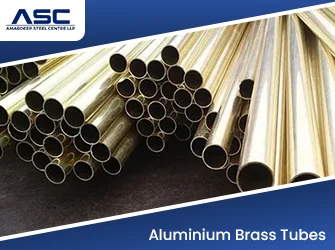
C68700 • CZ110 • CuZn20Al2As • CuZn22Al2 • JIS C6870 • NFA 51-102
Fast-moving seawater wears away most brass tubes from the inside. Turbulence at the tube inlet strips off the protective surface layer, and the metal underneath corrodes. Engineers call this impingement attack, and it is the main reason admiralty brass tubes fail in condensers where cooling water runs fast. Aluminium brass was developed to stop it.
The alloy is a copper-zinc brass of about 77.5% copper, 20.5% zinc and 2% aluminium, with a small arsenic addition. The aluminium forms a thin, self-healing oxide film that holds up against high-velocity salt and brackish water. The arsenic acts as an inhibitor against dezincification. That is why aluminium brass is the usual replacement when admiralty brass tubes have failed from
impingement. It is specified for condensers in both marine and land-based power stations, for desalination plants and for shipboard heat exchangers.
Amardeep Steel Centre supplies seamless aluminium brass tubes to ASTM B111, ASME SB111, BS 2871 Part 3, EN 12451, JIS H3300 and NFA 51-102. They come as straight tubes, U-bend tubes and low fin tubes from 6 mm to 150 mm OD, each with an EN 10204 3.1 mill test certificate.
Aluminium Brass Grades We Supply
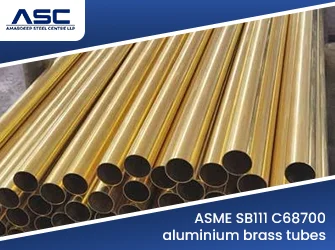
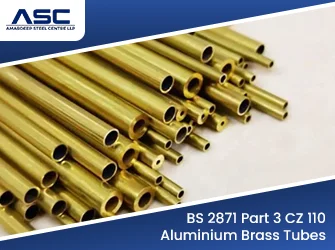
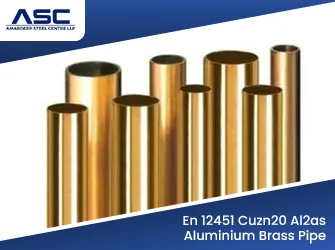
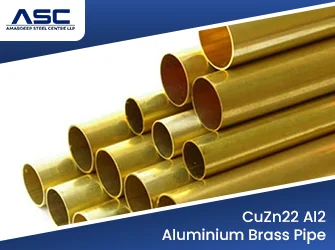
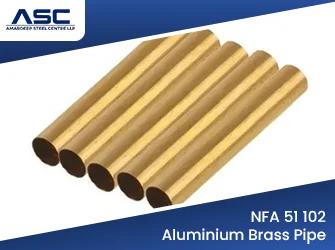
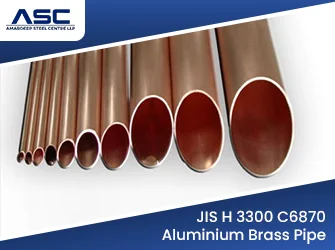
Also available: aluminium brass fin tubes and aluminium brass tapered tube plugs.
Specifications of Aluminium Brass Tubes
| Field | Details |
|---|---|
Grade / UNS | C68700 / CuZn20Al2As |
Governing standards | ASTM B111 / ASME SB111; BS 2871 Part 3; EN 12451; JIS H3300; NFA 51-102 |
Outer diameter (OD) | 6.0 mm to 150.0 mm |
Wall thickness | 0.5 mm to 10.0 mm |
Length | Up to 12 metres, or cut to length per drawing |
Temper conditions | O60 / F34 (light annealed), H / HH / QH (drawn / hard) |
Product forms | Straight tubes, U-bend tubes, low fin tubes |
Chemical Composition of Aluminium Brass (ASTM B111 C68700)
| Element | % |
|---|---|
Copper (Cu) | 76.0–79.0 |
Aluminium (Al) | 1.8–2.5 |
Arsenic (As) | 0.02–0.06 |
Lead (Pb) | 0.07 max |
Iron (Fe) | 0.06 max |
Zinc (Zn) | Remainder |
Mechanical Properties (C68700, O61 annealed)
| Property | Value |
|---|---|
Tensile strength | 345 MPa min |
Yield strength (0.5% extension) | 125 MPa min |
Grain size | 0.010–0.045 mm |
Aluminium Brass Tubes Physical Properties
| Property | Value |
|---|---|
Density | 8.33 g/cm³ |
Melting range | 932–971 °C |
Thermal conductivity | 100 W/m·K at 20 °C |
Electrical conductivity | 23% IACS |
Coefficient of thermal expansion | 18.5 × 10⁻⁶ /°C (20–300 °C) |
Modulus of elasticity | 110 GPa |
Equivalent Grades of Aluminium Brass Tubes
| Standard | Country | Designation |
|---|---|---|
ASTM B111 / ASME SB111 | USA | C68700 |
EN 12451 | Europe | CuZn20Al2As (CW702R) |
BS 2871 Part 3 | UK | CZ110 |
JIS H3300 | Japan | C6870 |
NFA 51-102 | France | CuZn22Al2 |
IS 1545 | India | CuZn21Al2As |
Aluminium Brass Seamless Tubes Size Chart
| Wall Thickness in MM | WT / Metre | Metric in MM | Wall Thickness | Imperial OD | Nominal Bore mm |
|---|---|---|---|---|---|
1.63 | 0.206 | 6.35 | 16G | 1/4″ | 3.09 |
0.71 | 0.077 | 4.76 | 22G | 3/16″ | 3.34 |
1.22 | 0.167 | 6.35 | 18G | 1/4″ | 3.91 |
0.91 | 0.172 | 7.94 | 20G | 5/16″ | 6.11 |
0.91 | 0.133 | 6.35 | 20G | 1/4″ | 4.53 |
1.63 | 0.345 | 9.52 | 16G | 3/8″ | 6.26 |
0.91 | 0.210 | 9.52 | 20G | 3/8″ | 7.70 |
1.22 | 0.271 | 9.52 | 18G | 3/8″ | 7.08 |
1.63 | 0.484 | 12.7 | 16G | 1/2″ | 9.44 |
0.91 | 0.288 | 12.7 | 20G | 1/2″ | 10.88 |
1.22 | 0.375 | 12.7 | 18G | 1/2″ | 10.26 |
0.91 | 0.550 | 14.29 | 20G | 9/16″ | 12.47 |
1.22 | 0.479 | 15.88 | 18G | 5/8″ | 13.44 |
1.63 | 0.622 | 15.88 | 16G | 5/8″ | 12.62 |
0.91 | 0.365 | 15.88 | 20G | 5/8″ | 14.06 |
1.63 | 0.761 | 19.05 | 16G | 3/4″ | 15.79 |
3.25 | 1.376 | 19.05 | 10G | 3/4″ | 12.55 |
1.22 | 0.583 | 19.05 | 18G | 3/4″ | 16.61 |
1.63 | 0.899 | 22.22 | 16G | 7/8″ | 18.96 |
0.91 | 0.442 | 19.05 | 20G | 3/4″ | 17.23 |
1.22 | 0.687 | 22.22 | 18G | 7/8″ | 19.78 |
1.63 | 1.038 | 25.4 | 16G | 1″ | 22.14 |
1.22 | 0.791 | 25.4 | 18G | 1″ | 22.96 |
1.63 | 1.177 | 28.58 | 16G | 1-1/8″ | 25.32 |
0.91 | 0.597 | 25.4 | 20G | 1″ | 23.00 |
1.63 | 1.316 | 31.75 | 16G | 1-1/4″ | 28.49 |
1.22 | 0.998 | 31.75 | 18G | 1-1/4″ | 29.31 |
1.63 | 1.454 | 34.92 | 16G | 1-3/8″ | 31.66 |
1.63 | 1.593 | 38.1 | 16G | 1-1/2″ | 34.84 |
3.25 | 3.040 | 38.1 | 10G | 1-1/2″ | 31.60 |
1.22 | 1.206 | 38.1 | 18G | 1-1/2″ | 35.66 |
1.22 | 1.410 | 44.45 | 18G | 1-3/4″ | 42.01 |
3.25 | 3.600 | 44.45 | 10G | 1-3/4″ | 37.95 |
3.25 | 4.140 | 50.8 | 10G | 2″ | 44.30 |
1.22 | 1.621 | 50.8 | 18G | 2″ | 48.36 |
3.25 | 4.700 | 57.2 | 10G | 2-1/4″ | 50.70 |
1.63 | 2.418 | 50.8 | 16G | 2″ | 47.54 |
3.25 | 5.248 | 63.5 | 10G | 2-1/2″ | 57.00 |
3.25 | 5.810 | 69.85 | 10G | 2-3/4″ | 63.35 |
1.63 | 2.703 | 63.5 | 16G | 2-1/2″ | 60.24 |
3.25 | 6.354 | 76.2 | 10G | 3″ | 69.70 |
3.25 | 7.460 | 88.90 | 10G | 3-1/2″ | 82.40 |
3.25 | 6.910 | 82.55 | 10G | 3-1/4″ | 76.05 |
3.25 | 8.020 | 95.25 | 10G | 3-3/4″ | 88.75 |
3.25 | 11.800 | 133.5 | 10G | 5″ID | 127.00 |
3.25 | 9.670 | 107.95 | 10G | 4-1/4″ | 101.45 |
3.25 | 13.900 | 158.9 | 10G | 6″ID | 152.40 |
Aluminium Brass Square Tubes Size Chart
| SIZE | WEIGHT | |
|---|---|---|
| mm | in | kg/m |
19.05 x 1.22 | 3/4 x 18G | 0.75 |
12.7 x 1.22 | 1/2 x 18G | 0.48 |
30.0 x 1.22 |
| 1.20 |
25.4 x 1.22 | 1 x 18G | 0.99 |
38.10 x 1.22 | 1-1/2 x 18G | 1.54 |
Aluminium Brass vs Admiralty Brass
| Aluminium brass | Admiralty brass | |
|---|---|---|
Composition | Cu 77.5, Zn 20.5, Al 2, As | Cu 71, Zn 28, Sn 1, As |
Protective film | Aluminium oxide, self-healing | Tin-enriched surface |
Best for | Clean seawater at higher velocity | Fresh and brackish water at low velocity |
Our page | This page |
For polluted seawater or very high velocities, consider copper-nickel 90/10 tubes.
Types of Aluminium Brass Tubes
- ASTM B111 C68700 condenser tube
- SB 111 C68700 heat exchanger tube
- CuZn20Al2As drawn tube
- Seamless aluminium brass tube
- Heavy wall C68700 pipe
- U-bend aluminium brass tube
- Low fin aluminium brass tube
Applications and Industrial Uses of Aluminium Brass Tubes
- Marine condensers
- Power plant heat exchangers
- Seawater cooling systems
- Desalination plants
- Shipboard heat exchangers
- Coastal power station cooling equipment
- Oil refinery heat exchangers
- Industrial water-cooled condensers
Frequently Asked Questions
1. What is C68700 aluminium brass tube?
A seamless tube of arsenical aluminium brass, about 77.5% copper, 20.5% zinc and 2% aluminium, made to ASTM B111. It is used for condensers and heat exchangers cooled by fast-flowing seawater.
2. What is the difference between aluminium brass and admiralty brass?
Aluminium brass forms a tough aluminium-oxide film that resists erosion where water flows fast. Admiralty brass suits fresh and brackish water at lower velocities.
3. What standards govern aluminium brass tube manufacturing?
ASTM B111 and ASME SB111 (C68700), BS 2871 Part 3 (CZ110), EN 12451 (CuZn20Al2As, CW702R), JIS H3300 (C6870), NFA 51-102 (CuZn22Al2) and IS 1545 (CuZn21Al2As).
4. What tube sizes are available?
Outside diameters from 6.0 mm to 150.0 mm, wall thicknesses from 0.5 mm to 10.0 mm, and lengths up to 12 metres or cut to length.
5. What testing certifications accompany these tubes?
Every order ships with an EN 10204 3.1 mill test certificate. Third-party inspection can be arranged on request.
6. Can aluminium brass tube be supplied with fins or as U-bends?
Yes. We supply straight tubes, U-bend tubes and low fin tubes.
Our Products

- CuZn30 Brass Tubes
- CuZn37 Brass Tubes
- CZ121 Brass Tubes
- C28000 60/40 Muntz Metal Tubes
- C37000 Muntz Metal Pipes
- C330 / C33000 Brass Pipes
- C33000 Brass Tubes
- C36300 Brass Tubes
- C36500 Brass Tubes
- C27450 Brass Tubes
- CuZn40 Brass Pipes
- CW705R Brass Pipes
- CZ112 Naval Brass Pipe
- CW719R Naval Brass Pipe
- CZ134 Naval Brass Pipe
- CZ114 Naval Brass Pipe
- CuZn37Pb1Sn1 (C48200) Naval Brass Rods
- Naval Brass Plates & Sheets
- C44300 Admiralty Brass Tubes
- BS 2871 CZ111 Admiralty Brass Tubes
- EN 12451 CW706R Admiralty Brass Pipe
- CuZn29Sn1 Admiralty Brass Pipe
- JIS H3300 C4430 Admiralty Brass Pipe
- NFA 51-102 Admiralty Brass Pipe